Conference & trends · CONFERENCE
GLP-1, wearables, HYROX: why PAFGYM spent years preparing for these three topics
Written so that people who exercise and trainers can understand why GLP-1, wearables, and hybrid racing rose at the same time, and decide what to bring to a first consultation.
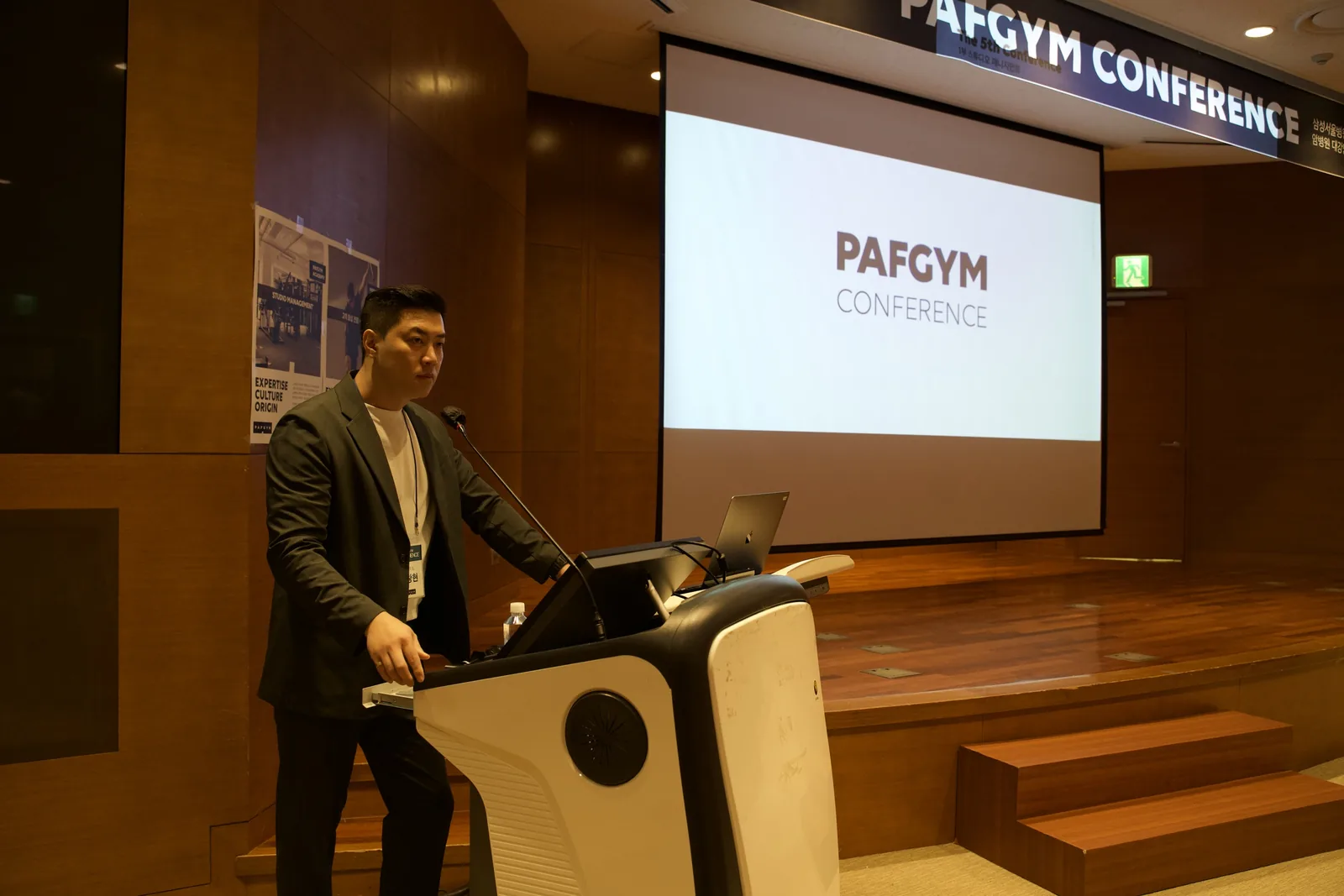
At the 5th PAFGYM Conference on August 30, 2025, the title co-CEO Cha Ju-ho chose for his talk was "Our clients have changed, but we have stayed the same." In the 2027 Top 20 fitness trends that the American College of Sports Medicine (ACSM) released the following October, three changes PAFGYM had been seeing in its consultation rooms appeared side by side. Wearable technology was number one again, exercise for weight management was sixth, and competitive fitness events such as HYROX entered the Top 20 for the first time at fifteenth.
These three are hard to see as fads that flare up for a year and pass. Wearables have held first place for a long time, GLP-1 has entered the exercise-for-weight-management item as a key term, and race-style events made the ranking for the first time. They are changes trainers cannot step around, and that is why the ACSM × PAFGYM Joint Conference on November 22 built its three sessions around these three topics. The ranking itself is explained in the trends column for trainers and the trends column for people who exercise. Before the ranking came out, what had PAFGYM trainers already tried in each area?
Three topics: ACSM ranking and PAFGYM's preparation
| Topic | ACSM 2027 rank | What PAFGYM did first | Now, in 2026 |
|---|---|---|---|
| Wearables and glucose data | 1st, wearable technology | Nov 2024: trainers wore CGMs themselves for 10 days | 1:1 glucose management program; blood pressure training launched |
| GLP-1 and weight management | 6th, exercise for weight management | Apr 2026: presented GLP-1 fitness guidelines at an outside seminar | All-staff training, in-depth study, checklists by phase |
| Hybrid racing | 15th, competitive fitness events (first entry) | May 2025: 12 trainers raced HYROX Incheon | 13 trainers have raced HYROX |
From numbers on the wrist to glucose curves
Wearables are a long-standing number one. In January 2023, PAFGYM's blog introduced wearables as that year's top ACSM trend and wrote that one day a single device would check blood pressure, blood glucose, and even blood oxygen saturation. In the 2027 survey, wearables ranked first for the tenth time.
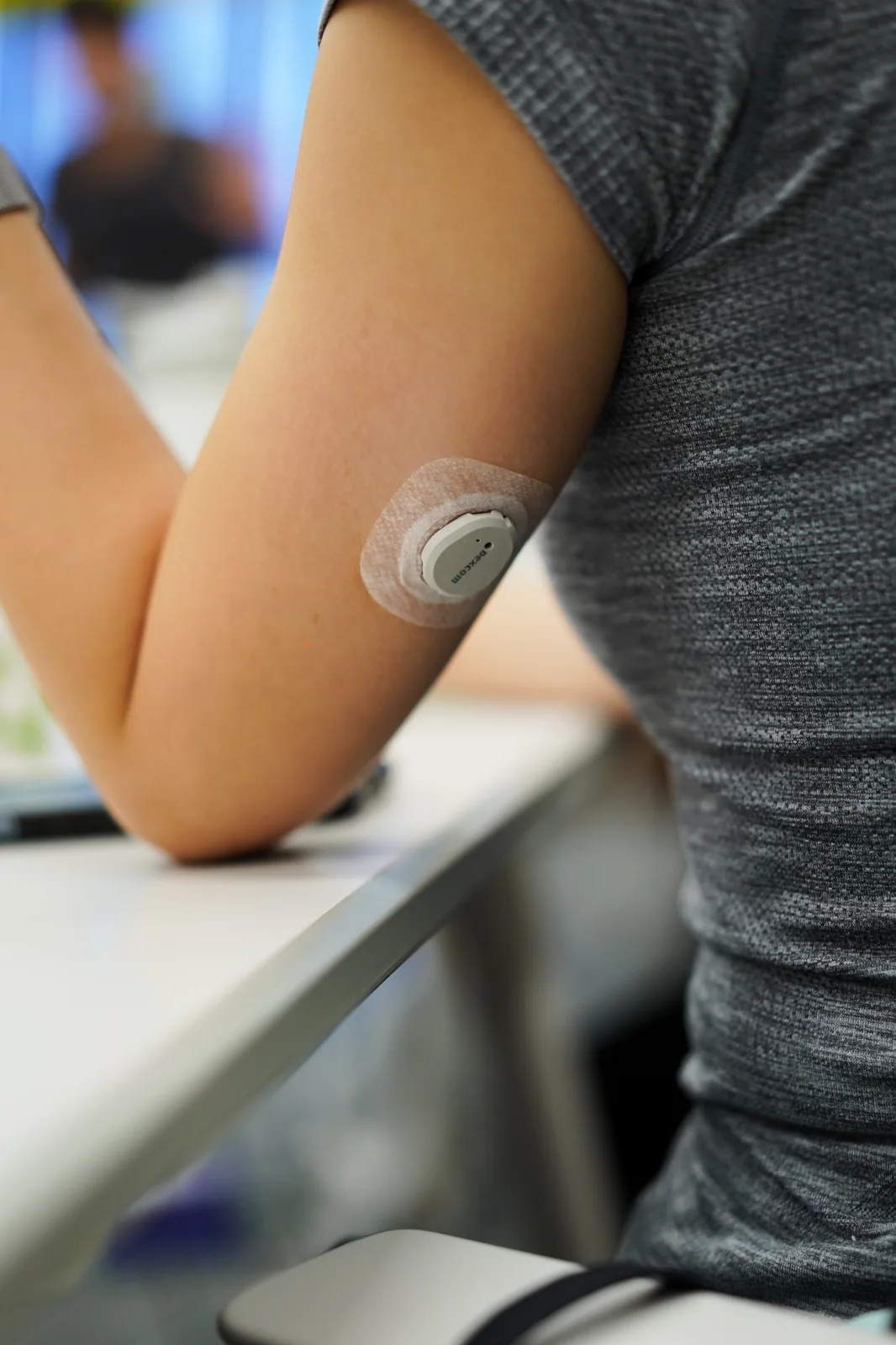
PAFGYM trainers first put those numbers on their own bodies in November 2024. Trainers, including the executive team, took two training sessions on the glucose management app PASTA at Kakao Healthcare's headquarters in Pangyo, then lived for ten days wearing a continuous glucose monitor (CGM). The blog reports that after seeing how the curve changed with portion size, eating order, after-meal habits, and sleep, many trainers picked up the habit of moving for 10 to 20 minutes after meals.
Three months later, on February 27, 2025, a 1:1 glucose management program launched, and on March 29 PAFGYM gave a joint presentation with Kakao Healthcare at the Circles Fitness Convention. In January 2026 the two companies signed a business agreement, and the July all-staff training covered the launch of blood pressure training and a guide to glucose- and data-based training. Then, in Session 2 on November 22, Kakao Healthcare Executive Vice President Kim Jun-hwan, Dr. Kong Sung-a of Samsung Medical Center, and PAFGYM Manager Ahn Jun-yong shared the stage.
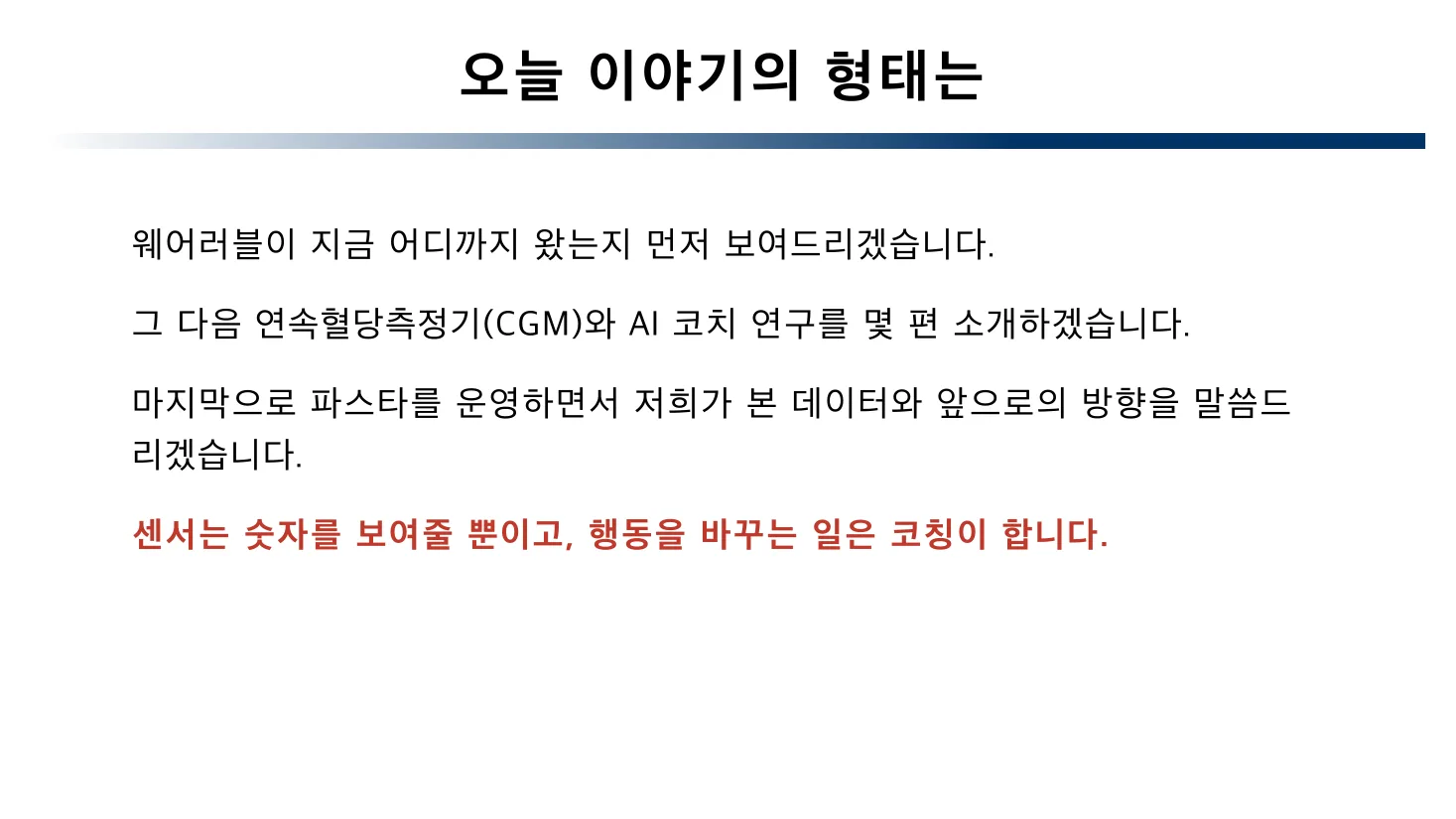
Over those two years, the questions in the consultation room changed too. The description of Manager Ahn Jun-yong's conference interview read: "if, instead of asking 'How is your diet going these days?', we look at the member's changes together on a glucose graph." Because glucose responses differ from person to person even after the same food, reading the numbers from a member's own body together with the trainer has become part of the session. Kim Jun-hwan put this in one line from the very start of his talk: "Sensors only show the numbers; coaching is what changes behavior." When and how much to move after meals is covered separately in When to move after meals, and how much.
Because glucose responses differ from person to person even after the same food, reading the numbers from a member's own body together with the trainer has become part of the session.
From "help me lose it" to "help me keep it"
Around the time trainers began reading glucose curves, more people came into the consultation room with a different question: people using GLP-1 obesity medications. In PAFGYM's own announcement, it was a period when "members using GLP-1 are increasing rapidly." In April 2026, co-CEO Cha Ju-ho presented on the GLP-1 market and fitness guidelines for different types of obesity in women at a Korean Association of Exercise Physiologists seminar, and at the July all-staff training he released a "GLP-1 Fitness Guide." It drew on some 200 related papers and covered reducing muscle loss during treatment, managing sleep and condition, and exercise, nutrition, and recovery standards for keeping weight off after stopping the medication.
In August, trainers held a two-hour in-depth study session. They divided the course of treatment into three phases, during medication, preparing to stop, and after stopping, built resistance training plans and session checklists for each, and decided to make this training a regular fixture. That same month, trainer Park Gyu-young of the Daechi studio posted a video telling people considering these medications that, along with how appetite goes down, they also need to prepare ways to protect muscle while losing weight.
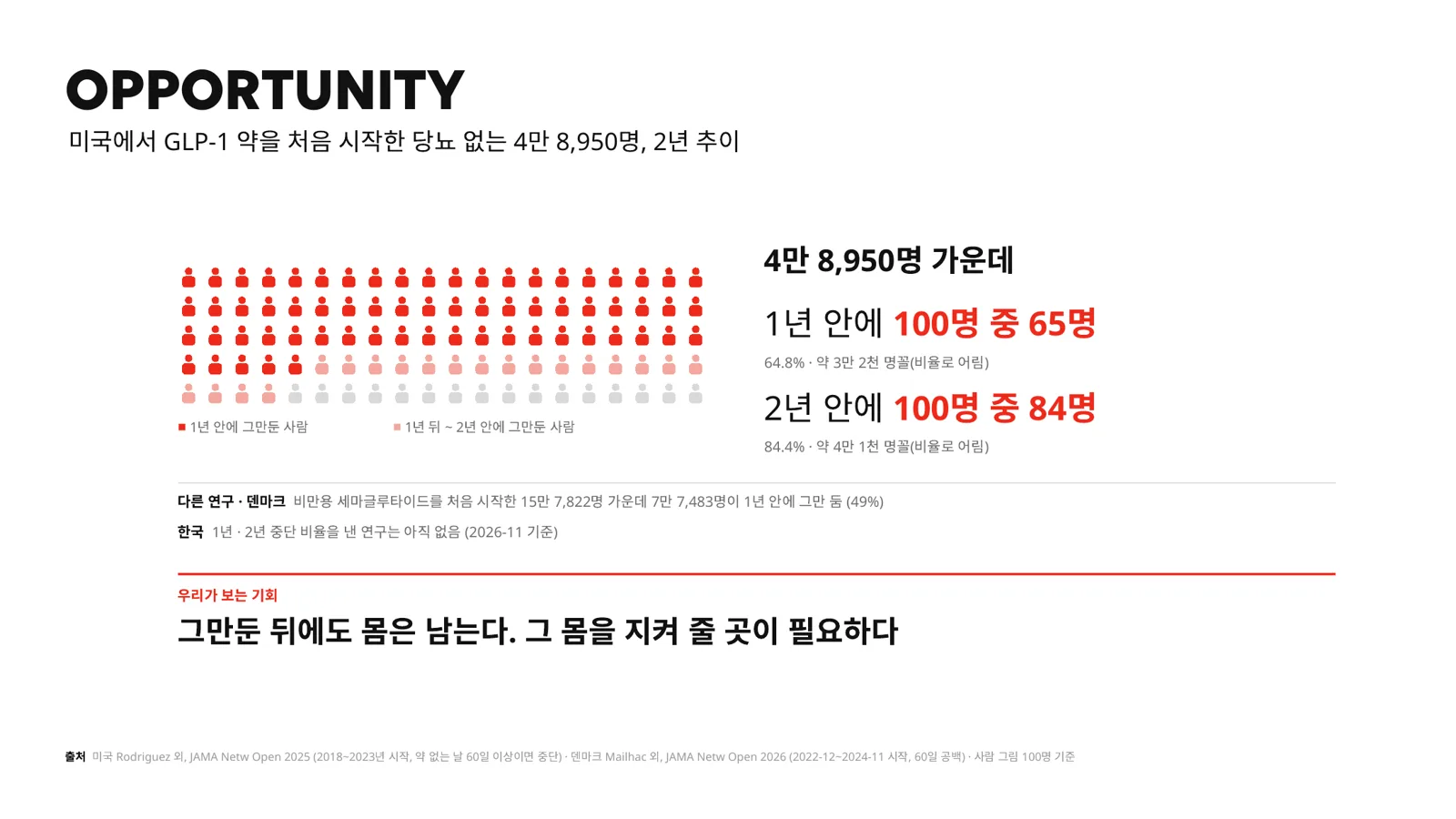
In the first talk of Session 1 on November 22, co-CEO Cha Ju-ho put this shift on a single slide: from "Help me lose it" to "Help me use it well, help me keep it." The number he showed alongside it was the share of people who stop the medication. Following 48,950 adults without diabetes in the United States who started a GLP-1 medication for the first time, 65 out of 100 had stopped within one year and 84 within two years (Rodriguez et al., 2025). The slide went on: "Even after you stop, the body remains. It needs a place to look after it." In an era when medication is used to bring weight down, what is left for trainers is protecting muscle and fitness in the meantime and taking over the body after the medication stops. Discuss any decision about medication with the doctor who prescribed it. You can read more about what exercise does in What the scale doesn't tell you.
Following 48,950 adults without diabetes in the United States who started a GLP-1 medication for the first time, 65 out of 100 had stopped within one year and 84 within two years (Rodriguez et al., 2025).

Exercise with a time and a date
The third change came from why people exercise. In May 2025, twelve PAFGYM trainers raced HYROX Incheon in relay teams. Trainer Hwang Hyun-woo of the Seocho studio began his race write-up with the sentence "I wanted to try a different kind of challenge." HYROX is a race that repeats a 1 km run and one functional exercise station eight times.
That November, Manager Jeong Ui-seong of the Hannam studio described HYROX in a race write-up on the blog as "a race anyone can finish," and wrote that his goal was to race doubles or relays together with members. He added that some members had actually asked to race with him. In 2026 the races kept coming. Jeong placed fourth in his age group in Pro Singles at the Hong Kong race in May, and in October took first in the mixed doubles age division at Urban Wave, a hybrid racing event. That same month, trainers from the Dogok, Daechi, Dogok Life, and Hannam studios entered Urban Wave Songdo in teams of two. According to the figure co-CEO Yoo Ji-sang gave in the first talk of Session 3, thirteen PAFGYM trainers have raced HYROX.
Co-CEO Yoo Ji-sang explained this change as follows: "People buy what can be measured, what has a date, and what they can show off." He closed his talk with the line "Clients with good performance are coming." Where PT clients used to be people starting strength training for the first time, now people who thought they did not need PT, and people who already train well, are coming for recording, measurement, and management. Trainer Hwang Hyun-woo, who raced HYROX Seoul again after two years, said he was struck by how much more popular the event had become since his first race and how much participants' performance had improved. HYROX sells the one day of the race, and the 52 weeks in between belong to the studio, as Yoo put it. If you are preparing for your first race, start with A first week of HYROX training.
HYROX sells the one day of the race, and the 52 weeks in between belong to the studio, as co-CEO Yoo Ji-sang put it.
What clients now bring with them
Put the three topics side by side and a common thread appears: clients now arrive with the basis for their exercise already in hand. Their wrists and arms carry numbers recorded by devices; some are taking a prescribed medication; some have already set a race date. All three can overlap in one person. Just as the conference material on the sixth-ranked ACSM trend, exercise for weight management, summed up its practical application as "pair medical treatment with exercise," the trainer's job is shifting toward weaving those pieces into one person's training plan.
That is why PAFGYM spent so long preparing these three topics. Trainers put on the sensors first, studied first, and raced first so they could already read what clients would bring in. So if you bring the three things below to your first consultation, the plan changes from your very first session.
- Records stored on your watch, ring, or app: heart rate, steps, sleep, and, if you have used a glucose sensor, the curves too
- If you are on a medication, that fact and your prescribing doctor's guidance: decisions about medication are for you and your doctor, and the exercise plan follows that guidance
- If there is a race you want to enter, its date: what to start with is set by the number of weeks left
Book a consultation at a studio near you.