SEOUL · FOR VISITORS
For those coming to HYROX Seoul: a body check in Seoul, before and after the race
Written for people traveling from other countries to race at HYROX Seoul, so they can plan their training load for the few days they spend in Seoul and, if needed, book a check-in session through PAFGYM's consultation request form.
HYROX Seoul 2026 Men's Doubles. Two people in matching green T-shirts crossed the finish line in 1:35:16. They were PAFGYM Seocho trainer Hwang Hyeon-u and co-CEO Yoo Ji-sang. Their team name was "Kkanbu," the Korean word for a close buddy who is always together. It was Hwang Hyeon-u's first HYROX Seoul in two years. His comments after the race were less about his own time than about the other participants. He said he was struck by how much more popular the event had become since his first race and how much better the participants' performance had gotten.
In the same race's Open Singles, Hannam Manager Jeong Ui-seong finished in 1:03:00. He had set a specific target time for this season and prepared for it step by step, but an off day on race day kept him from reaching it.
People coming from other countries to race in this event finish their training in their own country's gym. What is left for Seoul is the few days before and after the race, and the question of day-of condition that Manager Jeong Ui-seong checked again at the race.
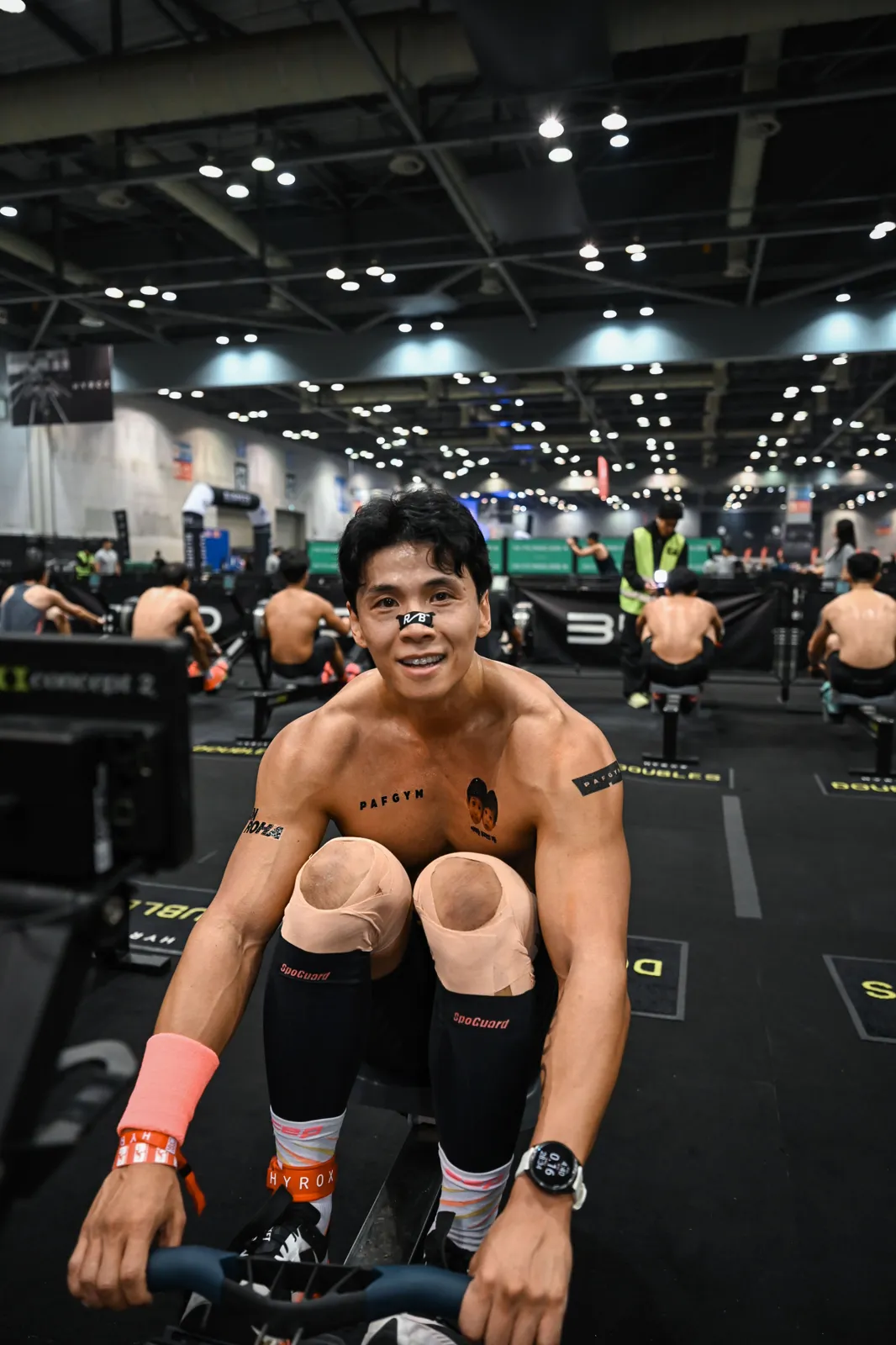
PAFGYM trainers at HYROX
HYROX Seoul was held at KINTEX in November 2026. KINTEX is an exhibition hall in Goyang, Gyeonggi Province, northwest of Seoul. PAFGYM is a one-on-one PT studio with locations in Gangnam-gu and Seocho-gu and in Hannam-dong, Yongsan-gu, having taught 550,000 sessions over 17 years. PAFGYM trainers enter this race as participants. A slide that co-CEO Yoo Ji-sang put up at the 2026 ACSM × PAFGYM Conference on November 22, 2026, said "13 of our seonsaengnim have already competed in HYROX." In Korea, trainers are commonly called "seonsaengnim" (teacher).
The same presentation had another slide: "HYROX sells one race day; the 52 weeks in between belong to the gym." The explanation was that what HYROX itself holds is the rules, the records, and the brand, and it has left the work of gathering and training people to each gym. For athletes who travel to race, those 52 weeks have already passed in their own country's gym.
PAFGYM trainers at HYROX Seoul 2026
| Division | Athletes | Record |
|---|---|---|
| Open Singles | Manager Jeong Ui-seong (Hannam studio) | 1:03:00 |
| Men's Doubles | Trainer Hwang Hyeon-u (Seocho studio) · co-CEO Yoo Ji-sang | 1:35:16 |
A pre-race check, once, in Seoul
At the conference, Dr. Kim Byeong-gon named four functions to check before a race: for the ankle, mobility and calf endurance; for the knee, deceleration and the ability to absorb load; and for the hip and trunk, propulsion and control. If you are traveling to race, you can check these four areas once after you arrive in Seoul.
PAFGYM's first trial lesson is 1:1 for 50 minutes. We hear your goals and any trouble spots, measure muscle mass and body fat with a body composition analyzer (InBody), check your movement, and finish with light exercise. Everyone's first trial lesson follows this order. If you write your division, race date, and any area that concerns you in the 'Message' box of the consultation request form, we can start from that in the first step, when we hear your goals and trouble spots.
What you do in your few days in Seoul is decided by how your body feels that day. Manager Jeong Ui-seong summed up the rules in his conference presentation: with muscle soreness, upper body and bike; with too little sleep, easy cardio; on a day you used your legs, bike or rowing. As signals to cut volume, he named two or more of sleep, soreness, and motivation being poor. What Manager Jeong Ui-seong posted on the Hannam studio's Instagram after the race points the same way: working off accumulated fatigue and checking in on your body are as much a part of race preparation as planning the training.
After the race, before you head home
Manager Jeong Ui-seong's presentation included a study (Martinho 2024) showing that recovery after high-intensity functional training, including CrossFit-style workouts, takes 48 to 72 hours. The same material said to keep high-intensity training to three days a week or fewer. Lowering the intensity the day after the race in Seoul fits that principle.
Dr. Kim Byeong-gon pointed to record keeping as the way to manage load and recovery: after each session, write down your own perceived exertion (session RPE), the distance you ran and the weights you handled at stations, and pain, sleep, and fatigue together. If you leave the race-day record in the same columns, it becomes the first line when you go home and start the next 52 weeks.
- If you want to check your movement once in Seoul before the race, apply for a first trial session (1:1, 50 minutes) through the consultation request form. In the 'Message' box, write your division, race date, and any area that concerns you.
- For the first few days after you arrive, choose exercise to fit that day's condition. On a day when you are short on sleep, do light cardio; on a day with muscle soreness, do upper body and the bike.
- Put off high-intensity exercise for 48–72 hours after a race.
- Write down how hard it felt, any pain, and your sleep the night of the race.
Traveling racers: a few days in Seoul
- 01
ARRIVE
Four checkpoints
Ankle (mobility · calf endurance) · knee (deceleration · load) · hip and trunk (propulsion · control)
- 02
BEFORE
By the day's condition
Soreness → upper body + bike · too little sleep → easy cardio · lower-body day → bike or rowing
- 03
RACE
Stick to the signals
Mild fatigue means pace adjustment · worsening pain or limping means stop
- 04
AFTER
48–72 hours
Put high-intensity exercise later · write down effort · pain · sleep
As co-CEO Yoo Ji-sang's slide put it, a race is one day. The first thing Trainer Hwang Hyeon-u, who returned to that one day after two years, talked about was how much better the other participants had become.
Get a consultation at the studio nearest you.