HYROX
A little over an hour of HYROX: what happens in the body
FOR EVERYONE · An edition for everyone who exercises
See the detailed edition for trainers →
Written so that someone about to enter HYROX for the first time can understand what happens in the body during the race and decide what to prepare first.
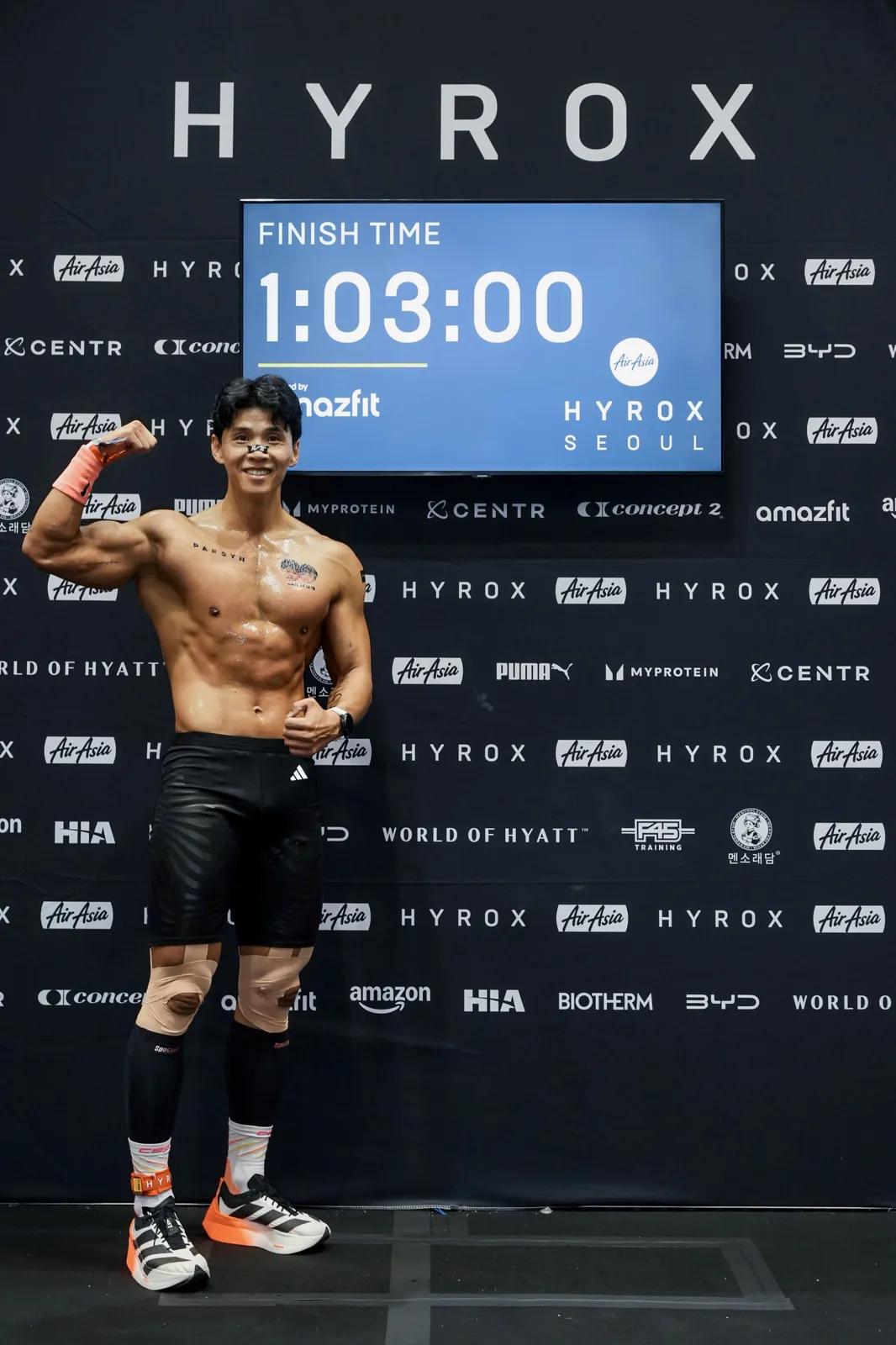
HYROX Seoul 2026 Open Singles. PAFGYM Hannam Manager Jeong Ui-seong's finish time was 1:03:00. He had set a target time for this season and prepared for it step by step, but on race day his condition did not cooperate and he did not reach the target. The comments in the Hannam studio's news after the race were not about training. They said that working off accumulated fatigue and checking in on your body are as important a part of race preparation as planning the training.
A little over an hour of running 8 km and linking eight exercise stations without a break. What happens in the body during that time?
An hour of running much harder than you'd expect
HYROX repeats the same pattern eight times: run 1 km, then do one station. The stations come in this order: SkiErg, sled push and pull, burpee broad jumps, rowing, farmers carry, sandbag lunges, Wall Balls.
In 2025, a research team in Germany had 11 recreational athletes with HYROX experience run a race under actual competition rules and measured how their bodies responded. The median finish time was 86.5 minutes, and about 80% of that time was spent with the heart in the "very hard" zone. It is a long event, yet most of the time was spent at "very hard" intensity. About 51 minutes went to running and about 33 minutes to the stations.
Where did the 86.5 minutes go? (11 recreational athletes, median)
The hard part is the stations, not the running
In the same study, the lactate that builds up in the blood as exercise gets harder, and the effort athletes feel themselves, were higher at the stations than in running. The hardest moment was the last Wall Balls. Heart rate, lactate, and perceived effort all peaked there.
There is one surprise. The heaviest sled push and pull were actually finished fastest. The median was 2:08 for the push and 2:35 for the pull. It is easy to be intimidated by the weight, but what takes up most of the race are the kilometers you have to run again on tired legs.

Running gets slower as the race goes on
Pro athletes are no different. When the results of 24 pro men at the 2025 Madrid race were analyzed, the first kilometer was run at over 16 km/h and the eighth came down to about 13.6 km/h. In the transition stretches between stations, it fell to 10.5 km/h.
That is why, at the conference, Dr. Kim Byeong-gon said he coaches athletes, when they leave a station and start running again, not to raise their speed in the first 100 to 200 m but to settle breathing and stride first. He also said it is not a method that research has settled as the one right answer, but a coaching tip used in the field.
Even pros get slower as the race goes on (km/h)
So here is a good way to prepare
- Running is the core. Around half of race time is running, and the fast times came from people with high maximal oxygen uptake, a large volume of endurance training, and low body fat. The same study found the demands for maximal strength and movement coordination to be moderate or lower.
- Fix the stations you are worst at first. In a study analyzing seven seasons of results, slower athletes lost more time at strength-type stations such as the sled and Wall Balls.
- Practice running right after a station on its own. Add a run immediately after one set at a station, and when you start running again, settle your breathing and stride first, then raise the speed.
- Watch fatigue and how the body feels. As Manager Jeong Ui-seong confirmed again at the race, working off accumulated fatigue and checking how your body feels is part of race preparation.
The same month, on the conference stage
On the 22nd of the same month, Manager Jeong Ui-seong took the stage at the 2026 ACSM × PAFGYM Conference. The title of his talk was "The Practice of Hybrid Racing Performance Programming." His slides included his own 2026 Seoul Marathon 10 km time of 43:37, followed by how to set HYROX running pace from a 10 km time, a weekly training table, and rules for handling fatigue and recovery. The fatigue and recovery slide carried the principle of keeping hard training of the same muscles 48 hours apart, along with a meta-analysis of 69 studies (Craven et al., 2022) finding that exercise performance drops 7.6% when sleep is short. That material is explained in plain terms in the next article.
1:03 was slower than the target. Manager Jeong Ui-seong looked for the difference in fatigue and physical condition.
Get a consultation at the studio nearest you.