Getting started & PT · PT PER WEEK
How many times a week should I do PT? What differs between 1, 2, and 3 sessions?
Written so that someone about to sign up for PT can decide for themselves how many times a week to come and what to do in a busy month.
In January 2014, a member started Pilates at PAFGYM. A year later the member moved to PT at the Dogok studio, and the assigned trainer changed several times along the way. In January 2024, the Dogok trainers celebrated that member's tenth anniversary. In the blog post written that day, the first thing the assigned trainer pointed out was that the member had come regularly twice a week for ten years.
Frequency is also what people ask most when they are about to sign up for PT. The question “How many times a week should I come?” is on the PAFGYM FAQ page too. The number changes how the schedule is built and how many weeks a package lasts, so it is natural to want to settle it at the start. The World Health Organization recommends that adults do strength training on at least 2 days a week, and the American College of Sports Medicine (ACSM) suggests 2 to 3 days a week for beginners. That is why PAFGYM suggests starting PT twice a week. So how do once a week and three times a week differ from twice a week?
In the blog post written that day, the first thing the trainer pointed to was that the member had come in regularly twice a week for ten years.
What does research say is different between 1, 2, and 3 sessions a week?
Training frequency research looks at two things separately: how many days a week you train, and how much you do in total across the week (the total number of sets).
In an analysis combining 10 studies on muscle size (Schoenfeld et al., 2016), training the same muscle twice a week or more built more muscle than once a week. Whether three times a week beats twice a week could not be answered, because too few studies compared them.
In an analysis combining 22 studies on strength (Grgic et al., 2018), strength rose more as frequency went up. The value that expresses the size of the change climbed from 0.74 at once a week to 1.08 at four or more times a week. But when only studies that matched total weekly volume were examined, the difference by frequency disappeared. A 2019 analysis of 25 studies reached the same conclusion for muscle size. It means that when volume is the same, you can choose how to split it across the week to suit your own life.
Applied to PT, it looks like this. The main reason three sessions a week beat two is that you end up doing more training. There is a limit to how much you can do in a 50-minute class, so with only one session a week your total weekly volume tends to fall short. Most of these studies involved people with no strength training experience, and when only middle-aged and older people were looked at, the difference by frequency was not clear.
Three sessions a week mostly beat two because you simply end up doing more training.
What happens to your body if you cut back to once a week in a busy month?
If the weekly volume decides the result, a month when work piles up and you have to cut sessions is a worry. One trial (Bickel et al., 2011) answered this question. Seventy adults aged 20 to 35 and 60 to 75 did strength training three times a week for 16 weeks. Over the next 32 weeks they were split into a group that stopped training completely, a group that cut volume to one third, and a group that cut volume to one ninth.
The younger group kept the muscle they had built even with reduced volume. In the group that cut to one third, muscle fibers actually grew a little more. The 60 to 75 group could not keep all of their muscle size on the reduced volume. As for strength, a large part remained in both age groups even among those who stopped training, and it dropped slightly only at the final measurement. The researchers concluded that the older you are, the more training you need to keep your muscle.
One third of three sessions a week is not exactly the same as one class a week. Still, PAFGYM does not discourage cutting back to once a week in a busy month. Instead, if you are older or are in a phase of building muscle, get a home workout from your trainer for the days without class.
What do I do on days without class?
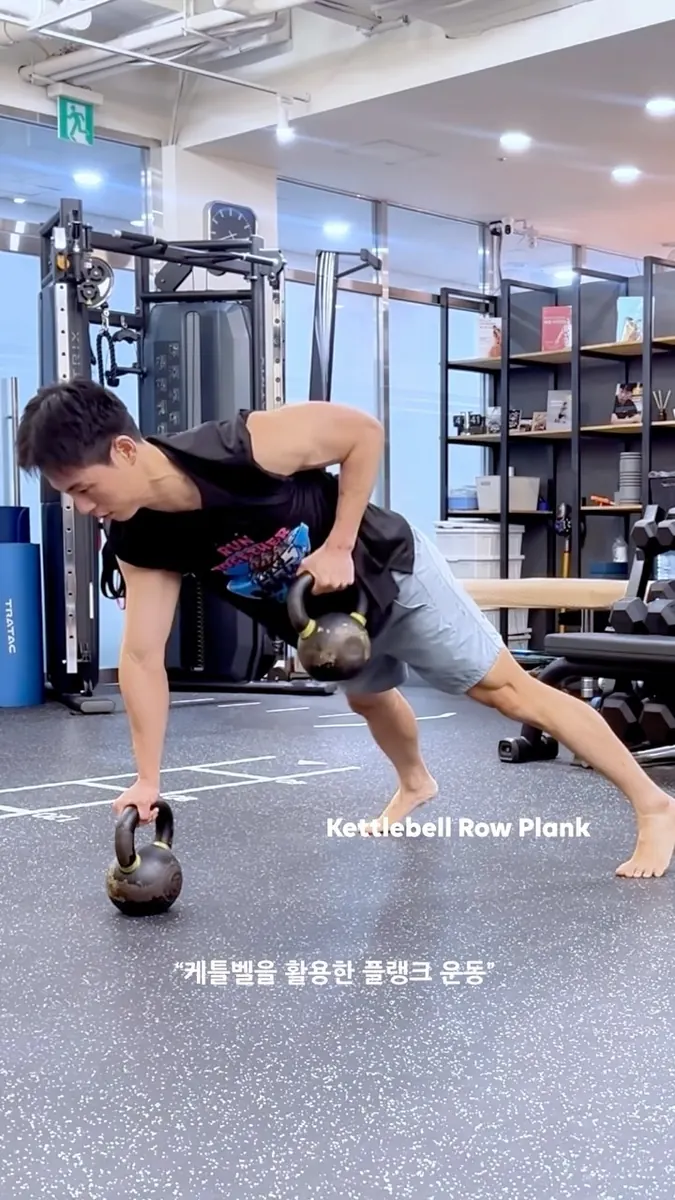
Whether you cut to once a week or keep going twice a week, you can make up the weekly volume on non-class days. If someone who has PT twice a week trains alone one more day, that makes three strength sessions a week. Your trainer picks the non-class workout from the movements you have learned in class. For the first few weeks, it would be movements like those in the table below.
Rest 1 to 2 minutes between sets, and the last 2 to 3 reps should feel hard while your form holds. ACSM suggests a weight you can lift 8 to 12 times for beginners, and says to raise the weight by 2 to 10% once you can do 1 to 2 reps more than the target.
On his blog, Trainer Park Ki-woon of the Dogok studio introduced a way to divide body parts by day for 2, 3, and 4 sessions a week. For twice a week, one day is chest, shoulders, and back of the arms, and the other day is back, lower body, and front of the arms. Large muscles take about 48 to 72 hours to recover, so the backbone of this method is building the plan so you do not train yesterday's body part again today.
There are times you should not do it. Rest on days when soreness from the previous day's class makes it hard to walk down stairs, and on days you have a fever or feel achy. If you have a diagnosed condition or are taking medication, talk with your doctor about how often and how hard to train, then let your trainer know.
Example movements to do alone on non-class days (first few weeks)
| Move | Reps and sets | Common mistakes |
|---|---|---|
| Chair squat (sit down onto a chair and stand up) | 10 to 15 reps × 2 to 3 sets | Knees caving inward, dropping onto the seat |
| Wall push-up | 10 to 15 reps × 2 to 3 sets | Lower back sagging and only the neck pushing forward |
| Hip raise (lying down with knees bent) | 12 to 15 reps × 2 to 3 sets | Arching the lower back to lift |
| Brisk walking | 20 to 30 minutes | Walking too long from the start |
If I come 8, 16, or 24 times, how many weeks does it last at each frequency?
Once you have chosen a frequency, what is left is the package math. PAFGYM PT pricing is set only by level and number of sessions, and the price is the same 365 days a year. The validity periods are 90 days for 8 sessions, 180 days for 16, and 270 days for 24. The table below shows how many weeks each package takes at 1, 2, or 3 sessions a week.
All three packages can be used up within their validity period even at once a week. Cutting back in a busy month will not leave you short on validity. Which package suits you is covered in a separate column on how many sessions to buy.
You do not have to decide the frequency before your first class. PAFGYM PT starts with three assessment sessions. On the first day there is a consultation, InBody (body composition measurement), and a movement screening. The second day looks at muscular endurance and the lower body, and the third at cardiorespiratory endurance and the upper body. The results are combined to set your training frequency, intensity, exercises, and time.
Looking back at the ten years of the member who started in 2014, what the trainer pointed out first was that the member had kept up twice a week, regularly, for ten years. In the research too, what decided the results was weekly volume, and people who kept going even at reduced volume held on to a large part of the strength they had built. So think of frequency not as a number you set once and forget, but as a number you adjust month by month to your schedule so that training never breaks off. Start with twice a week, move up to three times when you want to build strength and fitness and also manage body fat, and drop to once a week in months when work piles up while keeping it going. At your first assessment class, put your commute hours on the table and settle the days of the week with your trainer.
How long each package takes to use up
| Package (period) | 1x a week | 2x a week | 3x a week |
|---|---|---|---|
| 8 sessions (90 days) | 8 weeks | Week 4 | About 3 weeks |
| 16 sessions (180 days) | 16 weeks | 8 weeks | About 5 weeks |
| 24 sessions (270 days) | 24 weeks | 12 weeks | 8 weeks |
With all three passes, you can use every session within the validity period even if you come only once a week.
Book your first trial (1:1, 50 minutes, KRW 77,000) through our request form at the studio nearest you.